
Raw Materials for Life Sciences – Blocking Agents
rBSA (Recombinant Bovine Serum Albumin) – Pharma Grade
Recombinant Bovine Serum Albumin (rBSA) Pharma Grade is a non-animal albumin produced through controlled yeast expression, designed for pharmaceutical R&D and bioprocess development environments.
Functionally equivalent to conventional bovine serum albumin, it offers improved batch consistency and manufacturing control compared to plasma-derived BSA. Its animal-free origin and controlled production system make it particularly suitable for workflows where traceability, supply reliability, and reduced biological variability are essential.
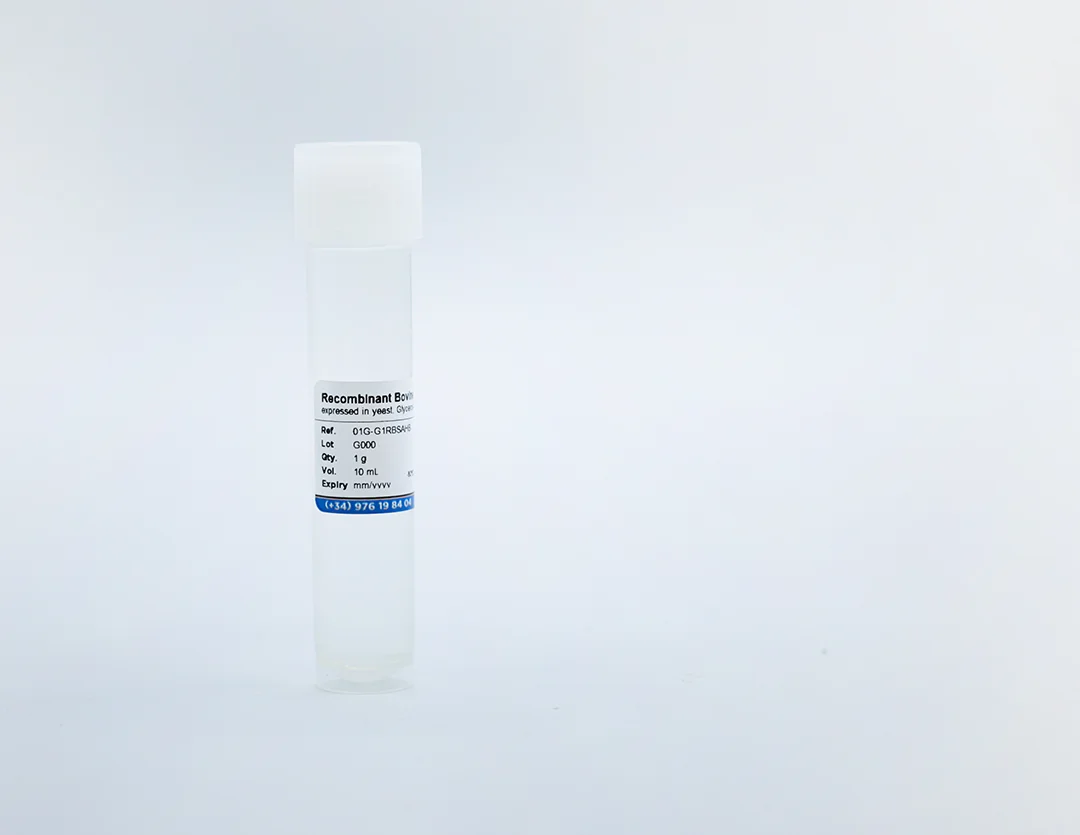
Catalog for rBSA – Pharma Grade
Cat. No.
Size
Format
MT01G-G1RBSAHB
1 g
Liquid, glycerol-free
MT01G-S1RBSAHB
1 g
Liquid, in glycerol
MT01G-L1RBSAHB
1 g
Lyophilized
Applications for rBSA – Pharma Grade
- Process Development
- Media optimization and performance screening
- Protein stabilization during formulation studies
- Early-stage formulation design (R&D)
- Buffer and excipient system evaluation
- Analytical Development
- Assay development and validation support
- RReference material and standard preparation
- Method comparability and robustness studies
- Bioprocess scale-up studies
- Raw material qualification workflows
- Process robustness and consistency studies
- Risk mitigation prior to GMP sourcing
- Supply chain stabilization during development phases
Documentation for rBSA – Pharma Grade
Cat. No.

Technical Data Sheet

Safety Data Sheet
Other information about rBSA – Pharma Grade (Performance data in assay development workflows)

Albumin concentration required to achieve comparable blocking performance. Data generated under R&D assay development conditions. Lower working concentrations may contribute to improved formulation control and process consistency.

Specific and non-specific signal behavior under controlled assay conditions. Representative assay data showing signal performance and background control under development conditions. Results may vary depending on system configuration.
For more information, please refer to the Technical Data Sheet or ask our team about this product.
FAQs (Frequently Asked Questions)
Fundamentals
What is recombinant BSA and how does it differ from animal-origin BSA?
Recombinant bovine serum albumin (rBSA) is produced through controlled yeast-based expression rather than extracted from bovine plasma.
Unlike animal-derived BSA, rBSA is manufactured in a defined, animal-free system, reducing biological variability and eliminating animal-origin risks. This controlled production environment supports improved batch consistency and traceability, which are especially relevant in pharmaceutical development workflows.
Does recombinant BSA maintain the same structure and function as bovine serum albumin?
Yes.
Levprot rBSA is designed to reproduce the native structure and biochemical functionality of bovine serum albumin, including its stabilizing capacity and binding properties.
The molecular identity remains equivalent, while the production method provides enhanced consistency and control compared to plasma-derived BSA.
Does Levprot rBSA share the same CAS number as animal-origin BSA?
Yes.
Levprot recombinant BSA corresponds to the same protein entity as bovine serum albumin and therefore shares the same CAS number.
The distinction lies in the production method and manufacturing control, not in the molecular identity of the protein.
How does rBSA compare to ultra-pure animal-derived BSA?
While ultra-pure plasma-derived BSA can achieve high purity levels, it remains inherently linked to biological variability and animal-origin supply chains.
Recombinant rBSA provides a controlled, animal-free alternative with improved batch consistency and reduced biological risk, supporting pharmaceutical development environments where reproducibility and traceability are critical.
Why is recombinant rBSA more functionally efficient than plasma-derived BSA?
Because recombinant rBSA is produced in a defined system, its binding sites are not pre-occupied by endogenous ligands commonly present in plasma-derived material.
This can result in improved functional availability, potentially allowing lower working concentrations depending on the system and application.
What does it mean that rBSA has empty binding pockets?
Plasma-derived BSA may carry naturally bound fatty acids, hormones, or other plasma components.
Recombinant rBSA is produced in a controlled expression system without those endogenous plasma ligands, leaving binding sites more available for interaction in formulation or stabilization workflows.
Applications
Can rBSA Pharma Grade replace plasma-derived BSA in existing bioprocesses?
In many pharmaceutical R&D and process development workflows, rBSA Pharma Grade can be implemented adapting the protocols of plasma-derived BSA.
However, as with any raw material change in regulated environments, in-house validation and comparability assessment are recommended.
What are the recommended storage conditions for rBSA Pharma Grade?
Storage conditions depend on format (lyophilized or liquid).
Detailed storage instructions are provided in the Technical Data Sheet. Proper storage ensures long-term stability and consistent assay performance.
At what concentration can rBSA replace conventional BSA?
Conventional plasma-derived BSA is often used around 1 g/L in many workflows.
Due to improved binding site availability and controlled production, rBSA may achieve comparable performance at lower concentrations depending on the application. Optimization is recommended during development.
Safety & Regulatory
Is rBSA Pharma Grade free from animal-origin materials and TSE/BSE risks?
Yes.
Levprot rBSA Pharma Grade is produced without animal-derived raw materials. As no bovine plasma is used in its manufacture, TSE/BSE-related risks associated with animal-origin materials are eliminated.
Is rBSA Pharma Grade manufactured under GMP conditions?
rBSA Pharma Grade is produced under controlled quality systems aligned with GMP principles.
It is intended for pharmaceutical R&D, process development, and qualification workflows. Final suitability for GMP manufacturing depends on the customer’s regulatory framework and validation requirements.
What documentation is available for rBSA Pharma Grade?
Pharma Grade includes batch-specific Certificate of Analysis, Technical Data Sheet, and Safety Data Sheet.
Additional documentation supporting quality control, traceability, and regulatory assessment may be provided upon request.
Supply
What are the main advantages of using animal-free rBSA?
Animal-free recombinant BSA offers several advantages compared to plasma-derived BSA:
- Elimination of animal-origin variability
- Improved batch-to-batch consistency
- Reduced biological risk
- Scalable production through fermentation
- Enhanced traceability for regulated environments
Is recombinant rBSA more cost-effective than plasma-derived BSA in practice?
While unit pricing may vary, improved consistency and reduced variability can lower overall development risk and validation complexity in pharmaceutical workflows.
Can rBSA be validated before committing to bulk volumes?
Yes.
Sample quantities are available to support internal evaluation, comparability studies, and raw material qualification prior to larger-scale sourcing decisions.