
Raw Materials for Life Sciences – Essential Reagents for Biotech Applications
rBSA (Recombinant Bovine Serum Albumin) – Molecular Biology Grade
Recombinant Bovine Serum Albumin Molecular Biology Grade (rBSA Molecular Biology Grade), a non-animal albumin equivalent to the common Bovine Serum Albumin (BSA), is heterologously expressed in yeast cells. Similar to BSA, it has demonstrated efficacy in preventing enzyme adhesion to reaction tubes and pipette surfaces, while also stabilizing certain proteins during incubation, especially relevant for overnight reactions.
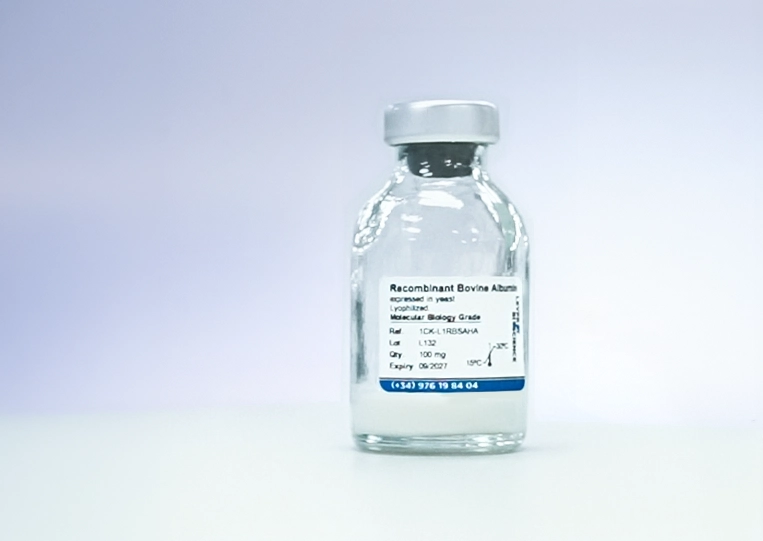
Catalog for rBSA – Molecular Biology Grade
Cat. No.
Size
Format
MT10K-G1RBSAHA
10 mg
Liquid, glycerol-free
MT10K-S1RBSAHA
10 mg
Liquid, in glycerol
MT10K-L1RBSAHA
10 mg
Lyophilized
Applications for rBSA – Molecular Biology Grade
PCR, qPCR and RT-qPCR formulations
- Polymerase and reverse-transcriptase stabilization.
- Reduction of protein adsorption to reaction tubes and pipette tips.
- Support for liquid and lyophilized reagent development.
Restriction and digestion
- Stabilization of restriction enzymes.
- Support for dilute enzyme solutions and low-volume reactions.
- Reduction of enzyme loss on plastic surfaces.
Nucleic-acid workflows
- Nucleic-acid manipulation.
- Enzyme-based sample-processing workflows.
- Applications requiring controlled nuclease and residual DNA specifications.
Protein and enzyme storage
- Stabilization during incubation.
- Support for frozen or lyophilized formulations.
- Short- and long-term enzyme storage.
Functional performance data
Real-time PCR data
Levprot rBSA Molecular Biology Grade was evaluated in a previously optimized real-time PCR formulation using both liquid and lyophilized mixtures.
Levprot rBSA was first compared with the commercial BSA at the same concentration of 0.1% with comparable results. It was then evaluated at progressively lower concentrations down to 0.005%, representing a 20-fold reduction, obtaining the same results in amplification performance as before. The same outcome was observed under the tested conditions in both formulation formats.
Restriction enzyme compatibility
Levprot rBSA Molecular Biology Grade was evaluated in DNA restriction-digestion reactions using different restriction enzymes and compared with a commercial animal-derived BSA. The expected digestion patterns were observed in the presence of Levprot rBSA, supporting its compatibility with the tested enzymes and reaction conditions.
These results indicate that Levprot rBSA can be used as a stabilizing and surface-protection protein in restriction-enzyme workflows, helping reduce enzyme adsorption to reaction vessels and supporting consistent activity in low-volume or dilute reactions.
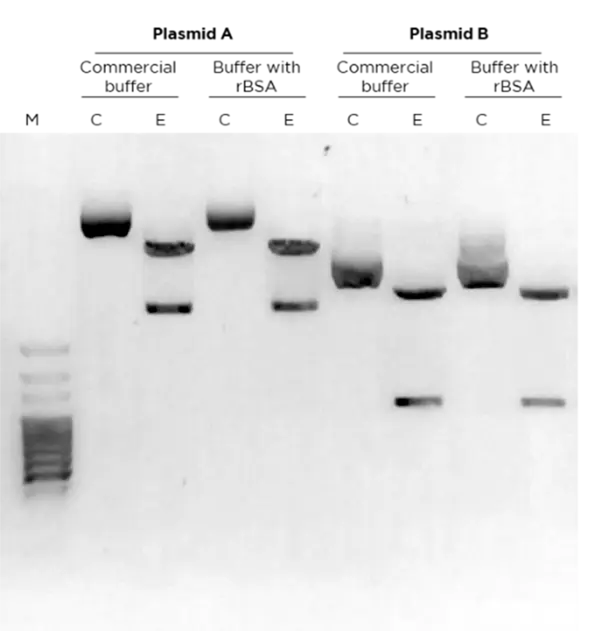
Figure 3. Agarose gel image showing DNA digestion with different digestion enzymes after treatment including either our recombinant bovine serum albumin (rBSA) agent or commercial animal-origin BSA agent. Before and after digestion are indicated as C (control) and E (enzyme), respectively.

Figure 1. Real-time PCR amplification using Levprot rBSA and an incumbent commercial BSA in a liquid formulation. Both BSA products were evaluated at 0.1%, while Levprot rBSA was additionally tested at 0.02%, 0.01%, and 0.005%. Serial dilutions of the dsDNA control ranged from 1 × 10⁸ to 1 × 10¹ copies per reaction.
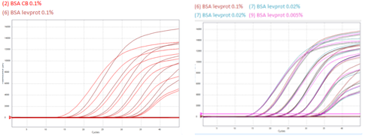
Figure 2. Real-time PCR amplification after lyophilization using Levprot rBSA and an incumbent commercial BSA. Both products were evaluated at 0.1%, while Levprot rBSA was additionally tested at 0.02%, 0.01%, and 0.005%. Serial dilutions of the dsDNA control ranged from 1 × 10⁸ to 1 × 10¹ copies per reaction. Comparable amplification profiles were observed across the tested conditions.
* Results are formulation-specific. The optimal rBSA concentration should be confirmed with the final polymerase, probe chemistry, sample matrix, excipients and lyophilization process.


FAQs (Frequently Asked Questions)
Fundamentals
What is recombinant BSA and how does it differ from animal-origin BSA?
Recombinant bovine serum albumin (rBSA) is a bioengineered version of BSA produced through yeast-based precision fermentation rather than extracted from bovine plasma.
While animal-origin BSA depends on blood collection and purification, rBSA is manufactured in a fully controlled, animal-free system.The key differences lie in origin, consistency, and risk profile. Recombinant BSA eliminates animal-derived contaminants, reduces batch-to-batch variability, and avoids TSE/BSE-related concerns, while maintaining the functional properties expected from BSA in biotech workflows.
For molecular biology applications, this controlled and animal-free origin is especially important to minimize background interference and experimental variability.
Does recombinant BSA maintain the same structure and function as bovine serum albumin?
Yes.
Levprot rBSA is designed to reproduce the native structure and biochemical functionality of bovine serum albumin. It retains the characteristic folding, binding capacity, and stabilizing behavior that make BSA essential as a carrier, protector, and buffering protein across multiple applications.
The difference is not in what the protein does, but in how it is produced and controlled. This functional equivalence is critical for molecular biology workflows that rely on predictable and reproducible protein behavior.
Does Levprot rBSA share the same CAS number as animal-origin BSA?
Yes.
Levprot recombinant BSA corresponds to the same protein entity as bovine serum albumin and therefore shares the same CAS number.
The distinction between recombinant and animal-origin BSA lies in the production method, not in the molecular identity of the protein.
How does rBSA compare to ultra-pure animal-derived BSA?
Compared to ultra-pure plasma-derived BSA, recombinant BSA offers greater consistency and lower biological risk without compromising functional performance.
While ultra-pure animal-derived BSA may still present inherent variability and animal-origin risk, Levprot rBSA provides a cleaner, more reproducible alternative for demanding molecular biology applications.
Why is recombinant rBSA more functionally efficient than plasma-derived BSA?
Recombinant rBSA is produced in a controlled fermentation system, resulting in a highly defined and consistent protein structure.
Unlike plasma-derived BSA, recombinant rBSA does not contain bound endogenous ligands and does not oligomerize, which improves availability of functional binding sites and enhances stabilizing performance in sensitive workflows.
What does it mean that rBSA has empty binding pockets?
Plasma-derived BSA may carry residual ligands naturally present in blood, partially occupying binding sites.
Recombinant rBSA is produced in a controlled system without these endogenous ligands, meaning its binding pockets are functionally available. This can improve blocking efficiency, protein stabilization, and assay performance.
Applications
Is rBSA Molecular Biology Grade suitable for enzyme stabilization?
Yes.
Levprot rBSA Molecular Biology Grade is suitable for enzyme stabilization in sensitive molecular biology workflows.
Its high purity and controlled contaminant profile help preserve enzymatic activity without introducing interfering substances.
Does rBSA Molecular Biology Grade meet the requirements for molecular biology workflows?
Yes.
This grade is specifically designed to meet the demands of molecular biology applications, where low background, high purity, and reproducibility are critical.
It is optimized for use in enzymatic reactions, nucleic acid handling, and other sensitive laboratory workflows.
Is this rBSA RNase-free, DNase-free, and DNA-free?
Yes.
Levprot rBSA Molecular Biology Grade is manufactured under strict controls to ensure it is RNase-free, DNase-free, and DNA-free, making it suitable for highly sensitive molecular biology workflows.
Can rBSA Molecular Biology Grade directly replace animal-derived BSA in existing molecular biology protocols?
What are the recommended storage conditions for rBSA Molecular Biology Grade?
Storage conditions depend on the specific format (liquid or lyophilized). In general, lyophilized material should be stored refrigerated and protected from moisture, while liquid formulations should be stored at recommended temperatures to preserve stability.
Detailed storage and handling instructions are provided in the product documentation.
At what concentration can rBSA replace conventional BSA?
While plasma-derived BSA is commonly used at concentrations around 1 g/L, Levprot rBSA can often achieve comparable or improved performance at significantly lower concentrations, typically in the range of 10–50 mg/L, depending on the system and sensitivity of the assay.
This increased functional efficiency contributes to overall cost-effectiveness in many applications.
Safety & Regulatory
Is rBSA Molecular Biology Grade free from animal-origin components?
Yes.
Levprot rBSA Molecular Biology Grade is fully animal-free and produced using yeast-based precision fermentation.
No animal-derived raw materials are used at any stage of production.
Does rBSA Molecular Biology Grade eliminate TSE/BSE-related risks?
Yes.
Since Levprot rBSA is produced through yeast-based precision fermentation without any animal-derived raw materials, it eliminates risks associated with transmissible spongiform encephalopathies (TSE/BSE) and simplifies regulatory documentation.
Is rBSA free from endotoxins, IgG, viruses, and residual animal contaminants?
Yes.
Recombinant production in yeast avoids contaminants typically associated with plasma-derived materials, such as IgG, animal viruses, and other blood-borne components. The controlled fermentation and purification process supports a highly defined and reproducible contaminant profile.
How is residual DNA controlled in yeast-expressed rBSA?
Residual DNA is controlled through validated purification processes and quality testing. Batch-specific analyses are performed to ensure compliance with molecular biology requirements.
Additional information and documentation can be provided upon request to support regulatory or validation needs.
Supply
What are the main advantages of using animal-free rBSA?
Animal-free recombinant BSA offers several advantages compared to plasma-derived BSA:
- No animal-origin raw materials
- No TSE/BSE-related risk or documentation
- Improved batch-to-batch consistency
- Scalable and secure supply through fermentation
- Better alignment with regulatory, ethical, and sustainability requirements
These advantages make rBSA particularly well suited for molecular biology workflows requiring low background, high purity, and high reproducibility.
Is rBSA production scalable for industrial demand?
Yes.
Yeast-based precision fermentation enables scalable and secure production, with reliable supply independent of animal-derived supply chains, supporting long-term availability for industrial and regulated applications.
Is recombinant rBSA more cost-effective than plasma-derived BSA in practice?
Although the unit price per gram may differ from conventional BSA, rBSA can often be used at significantly lower concentrations due to its functional efficiency.
This reduced usage, combined with improved reproducibility and lower risk, can contribute to overall cost-effectiveness in many workflows.
Can rBSA be validated before committing to bulk volumes?
Yes.
Validation samples are available to support performance testing in specific workflows. Customers are encouraged to perform in-house equivalence testing to determine optimal concentrations before scaling up to production volumes.