
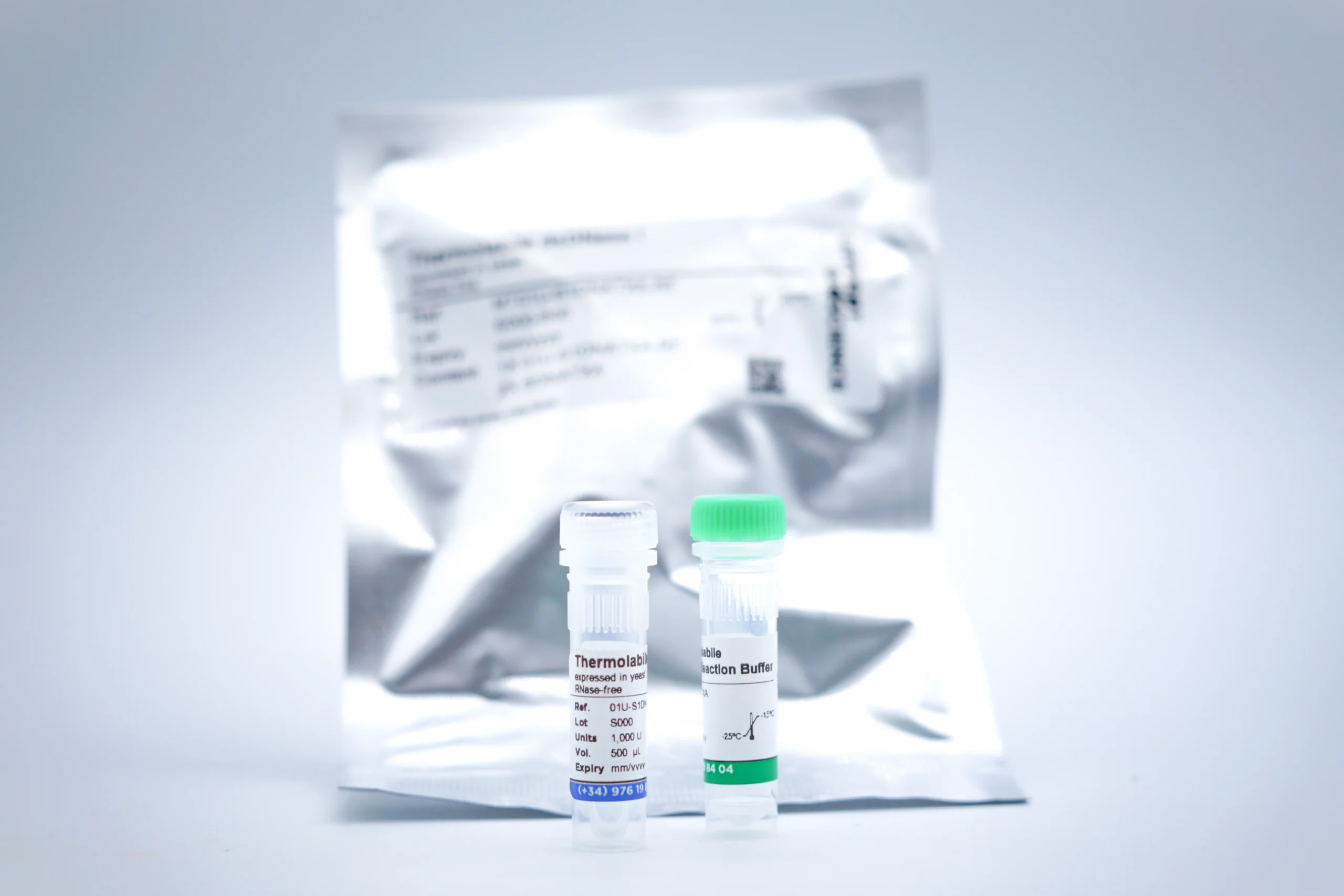
Introduction
Accurate RNA analysis depends on one critical factor: the complete removal of contaminating DNA.
Even trace levels of genomic DNA can lead to false positives in RT-PCR, distort RNA-seq datasets, and compromise experimental reproducibility. This is where thermolabile dsDNase becomes essential in modern molecular biology workflows.
Unlike conventional DNases, which often require additional purification or chemical inactivation steps, thermolabile dsDNase enables efficient DNA degradation followed by simple heat inactivation. This not only simplifies workflows but also minimizes RNA loss and handling variability.
As a result, researchers can achieve higher data quality while improving efficiency in both low- and high-throughput environments.
Specific Context
Standard RNA preparation workflows typically include a DNase treatment step to remove genomic DNA contamination before downstream applications such as RT-PCR or RNA sequencing. This process usually involves enzymatic digestion followed by purification or chemical inactivation.
However, even minimal residual DNA, at picogram levels, can be amplified during qPCR, leading to inaccurate quantification.
Additionally, in high-throughput or automated workflows, these extra cleanup steps introduce inefficiencies, increase turnaround time, and elevate the risk of RNA degradation or sample loss.
 RNA workflow DNA removal step 3D graphic depiction
Limitations of Current Approaches
Traditional DNase-based strategies present several technical and operational limitations:
- Non-specific activity, potentially affecting RNA integrity.
- Complex inactivation protocols requiring EDTA or purification columns, which increase costs.
- Extended processing times, adding up to 30–60 minutes per workflow.
- Sample loss during cleanup, especially critical for low-input samples.
- Limited compatibility with automation.
From a workflow perspective, these limitations create friction, particularly in applications requiring high reproducibility and scalability.
Our Solution: Levprot Thermolabile dsDNase
Levprot’s thermolabile dsDNase is engineered to address these challenges by combining high specificity with simplified workflow integration.
Key features
- Selective degradation of double-stranded DNA, or dsDNA.
- Optimized digestion at 37 °C for 30 minutes.
- Complete heat inactivation at 55 °C, eliminating purification steps.
- RNase-free versions available.
“The idea was simple: design it to integrate directly into RNA workflows, reduce processing time, and deliver more consistent results.”
– Laura Pedrós, Business Developer at Levprot Bioscience
Scientific Basis
Thermolabile dsDNase is an endonuclease that hydrolyzes phosphodiester bonds in DNA, producing oligonucleotides with 5’-phosphate and 3’-hydroxyl termini. Its defining features are its strong preference for double-stranded DNA, minimal activity on single-stranded DNA and RNA in the presence of Mg2+ ions, and its ability to be rapidly and completely inactivated by heat.
Key performance characteristics
- High activity up to 45 °C.
- Gradual activity loss above 45 °C.
- Complete inactivation at 55 °C within 5–20 minutes.
- Optional irreversible inactivation with 1 mM DTT.
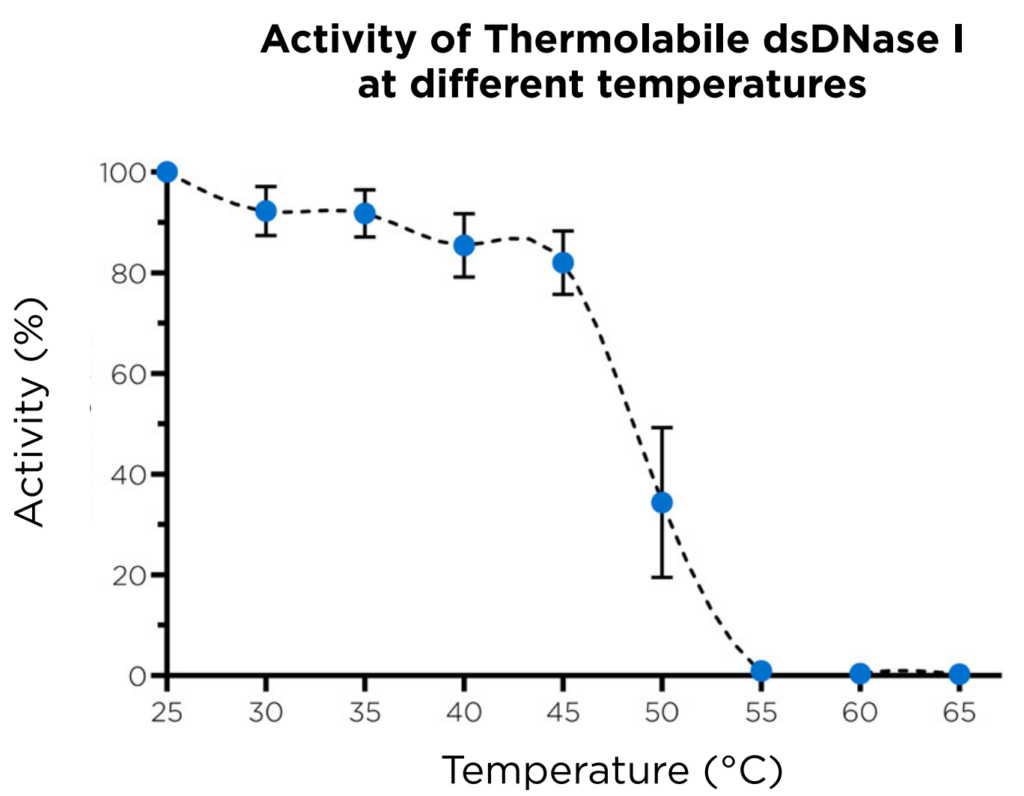 The activity profile shows more than 80% activity maintained up to 40–45 °C, followed by a sharp drop to zero at 55 °C.
Additionally, strict quality control ensures batch-to-batch consistency, with ≤8% deviation in enzymatic activity, supporting reproducible experimental outcomes.
Applications
Levprot’s thermolabile dsDNase is designed for integration across a wide range of molecular biology applications:
- Removal of genomic dsDNA from RNA samples prior to RT-PCR.
- RNA-seq sample preparation.
- DNA cleanup after cell lysis.
- Removal of DNA contamination in dNTPs and primers.
- Molecular cloning and in vitro transcription.
Specific Application: RT-PCR Workflows
In RT-PCR workflows, thermolabile dsDNase can be directly applied:
- Add approximately 0.4 µL enzyme per 20 µL reaction.
- Perform digestion and heat inactivation.
- Proceed immediately to amplification.
This results in:
- Complete removal of DNA-derived amplification signals.
- Reduced false positives.
- Improved reproducibility and data reliability.
Such improvements are particularly relevant in gene expression studies, diagnostics, and RNA-based assay development.
Strategic Solution
Levprot’s thermolabile dsDNase is part of a broader strategy to optimize molecular biology workflows through precision and scalability.
Produced using precision fermentation in yeast, it ensures:
- High batch consistency.
- Scalable manufacturing.
- Animal-free production.
- Compatibility with regulated environments.
This positions Levprot as a reliable partner for both research and industrial applications requiring robust and reproducible enzymatic solutions.
Levprot vs Standard DNase
| Feature | Standard DNase | Levprot Thermolabile dsDNase |
|---|---|---|
| Specificity | Moderate | High, dsDNA-specific |
| Inactivation | Chemical / purification | Heat, 55 °C |
| Workflow complexity | High | Low |
| RNA preservation | Variable | High |
| Automation compatibility | Limited | High |
Conclusion
The thermolabile dsDNase from Levprot provides a precise, efficient solution for removing DNA contamination from RNA samples without adding complexity to your workflow.
By combining dsDNA specificity, heat inactivation, and flexible formats, it enables faster, cleaner, and more reproducible results across molecular biology applications.