
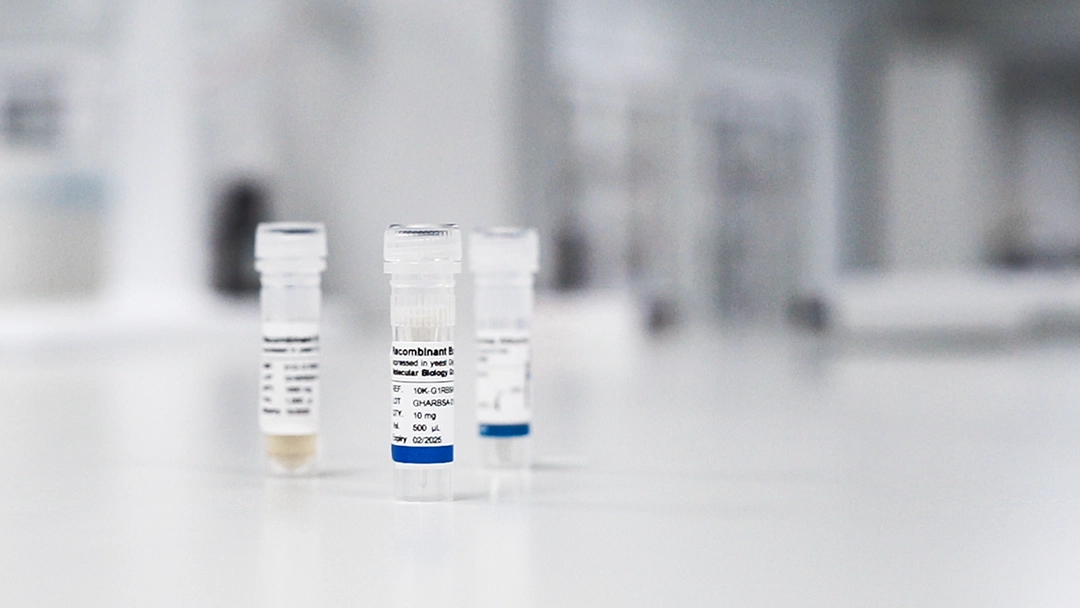
Key Takeaways
- Animal-derived BSA remains workable for routine, low-sensitivity blocking workflows where modest lot variation does not change the analytical outcome.
- Recombinant BSA (rBSA) is the stronger choice for PCR, restriction digests, serum-free media, and regulated manufacturing because it removes animal-origin sourcing from the production chain and supports more consistent input quality.
- In cell and gene therapy manufacturing, albumin is not just a formulation detail. Under ISO 20399:2022, when it comes to purchase and logistics, materials such as serum, culture media, enzymes, cytokines, growth factors, and antibodies fall within the ancillary-material framework used during cell processing for buyers.
Decision Matrix: Which BSA Is Right for You?
| Workflow priority | Better choice | Why |
|---|---|---|
| Lowest upfront cost for routine blocking | Animal-derived BSA | Legacy performance is often sufficient when small lot differences are acceptable |
| Low-background immunoassays | Recombinant BSA | A more defined input is easier to standardize and troubleshoot |
| PCR, restriction digests, and nuclease-sensitive workflows | Recombinant BSA | Defined enzyme-support systems align better with high-sensitivity molecular biology |
| Serum-free or chemically defined media | Recombinant BSA | Defined workflows work best with defined components |
| Regulated cell or gene therapy manufacturing | Recombinant BSA | Animal-origin documentation and risk assessment are simplified |
This matrix reflects the differences in source control, ancillary-material requirements, TSE-related documentation, defined-media use, and documented adoption of recombinant albumin in enzyme buffer systems.
What is the practical difference between animal-derived BSA and recombinant BSA?
The practical difference is that animal-derived BSA is a purified biological extract, while recombinant BSA is a defined protein produced through controlled expression and purification. Plasma-derived albumin begins with a heterogeneous animal source and is enriched through fractionation. Recombinant albumin begins with a defined gene sequence and is manufactured in a controlled fermentation process, typically in yeast systems such as Pichia pastoris (also known as Komagataella phaffii).
That distinction matters because it changes how much upstream variability enters the final reagent. In practical terms, plasma-derived BSA often requires grade-specific controls such as fatty-acid-free, globulin-free, IgG-free, nuclease-free, or protease-free specifications for sensitive applications. The commercial existence of those specialized grades reflects a real technical need to manage residual background components in legacy serum-derived albumin workflows.
What is Cohn fractionation, and why does it matter?
Cohn fractionation is a multi-step cold-ethanol precipitation process used to separate plasma proteins by manipulating ethanol concentration, pH, ionic strength, temperature, and protein concentration. In the original logic of the process, albumin is recovered in Fraction V, which is why “Fraction V” remains common commercial language for serum albumin products.
It matters because the process enriches albumin from a complex biological mixture rather than building the protein in a defined system. That makes animal-derived BSA a purified plasma product, not a compositionally simple reagent. For routine applications this is often acceptable. For high-sensitivity assays, long culture timelines, or tightly controlled manufacturing environments, that upstream complexity becomes an operational burden.
When it comes to animal-free reagents, this process is skipped completely, making it easier for the supplier to provide a consistent product.
How is recombinant BSA produced?
Recombinant BSA is produced in engineered expression systems that synthesize the bovine albumin sequence during controlled fermentation, followed by post-fermentation purification. Yeast platforms such as Pichia pastoris are widely used in recombinant protein production because they combine scalable cultivation with eukaryotic protein-processing capability and have become one of the most commonly used yeast-based expression systems.
This production model changes the quality profile of the final reagent. Instead of removing albumin from plasma and then managing residual biological complexity, recombinant manufacturing starts from a defined construct and standardized process conditions. That is why microbial-expressed albumin is better aligned with reproducible research, plasma-free workflows, and animal-origin-free sourcing strategies.
Why does recombinant BSA improve reproducibility?
Recombinant BSA improves reproducibility because it replaces a variable plasma input with a controlled manufacturing system. That shift reduces one of the oldest but least visible sources of assay drift: raw-material inconsistency between lots.
The same logic appears in assay literature. A Journal of Immunological Methods paper reported nonspecific binding interactions with some BSA preparations used as ELISA blockers and concluded that not all BSA preparations are alike. When a blocking reagent itself becomes a source of variability, a defined recombinant alternative becomes the more defensible input.
Why is recombinant BSA preferred in regulated manufacturing?
Recombinant BSA is increasingly preferred in regulated environments because it supports better raw-material definition and traceability. These types of materials may come into contact with the active substance during processing without intentionally becoming part of the final cell or gene therapy product.
In this context, the selection of albumin is not a secondary decision; it is part of the overall quality strategy.
Recombinant BSA is also preferred because it removes bovine-origin sourcing from the manufacturing chain. That means every animal-origin input creates additional documentation and risk-review work, even when the final assessed risk is very low.
Why does animal-free sourcing reduce biological-risk burden?
Animal-free sourcing reduces biological-risk burden because it eliminates bovine-derived material from the reagent itself. WHO states that precautionary regulatory guidelines exist for transmissible spongiform encephalopathies (TSEs), including bovine spongiform encephalopathy (BSE) and EMA explains that bovine-derived materials trigger formal risk assessments covering source, tissue, and processing.
That does not mean every bovine-derived reagent is unsafe. It means bovine-derived reagents are regulated through a more complex risk framework. Recombinant BSA shortens that path by eliminating the animal-origin category at the material level. For procurement, QA, and CMC teams, that simplification is often as important as the protein’s biochemical function.
Why is recombinant BSA better for serum-free and chemically defined media?
Recombinant BSA is better for serum-free and chemically defined media because defined systems perform best when each component is known, controlled, and reproducible. NIH Common Fund stem cell resources include a protocol for iPSC derivation in chemically defined medium, and that protocol explicitly states that stem-cell quality is strongly influenced by animal products and feeder cells. It further describes enzyme-free, xeno-free, chemically defined culture conditions using E8 medium with vitronectin or a synthetic surface.
That makes rBSA a better fit for modern media design. Plasma-derived albumin introduces animal-origin variability into a workflow that is deliberately being stripped of undefined inputs. Recombinant, animal-origin-free albumin supports the carrier and stabilizing functions of albumin without pulling the whole system back toward serum-like complexity.
Where does recombinant BSA show the clearest performance advantages?
Recombinant BSA shows the clearest performance advantages in workflows where lot-to-lot uniformity, low background, or raw-material definition directly affect the result. The more sensitive the assay or manufacturing process, the more valuable a defined albumin input becomes.
Why does a defined albumin input matter in immunoassays?
A defined albumin input matters in immunoassays because blocking variability directly affects background behaviour. Traditional BSA, being naturally derived, contains variable residual components that can cause non-specific binding and increase background. This is why multiple “cleaned” variants (e.g., globulin-free or IgG-free) are needed to improve performance.
Recombinant BSA, however, is produced in a controlled way with much higher purity and consistency, inherently reducing non-specific interactions and eliminating the need for specialized variants.
Recombinant albumin addresses the same problem from the manufacturing side by starting with a more standardized input instead of solving it lot by lot.
How should labs transition from animal-derived BSA to recombinant BSA?
A successful transition starts with controlled replacement, not with direct substitution without optimization.
Step 1: Identify every workflow where BSA affects the outcome
Map every assay, buffer, and media system that uses BSA as a blocker, stabilizer, carrier protein, or media component. Prioritize workflows where background signal, enzyme recovery, cell phenotype, or release testing depends on lot consistency.
Step 2: Replace legacy concentrations with a short optimization study
Run a structured dilution series instead of assuming the historical concentration is still optimal. A cleaner albumin input often supports equal performance at a different working concentration, and the transition study should establish that range before rollout.
Step 3: Define the readouts before testing
Set acceptance criteria in advance. Use readouts that match the workflow: signal-to-noise ratio, PCR robustness, restriction digest performance, cell growth, morphology, differentiation markers, and background interference.
Step 4: Update supplier, quality, and change-control documentation
Revise raw-material specifications, supplier records, method notes, and internal change-control files. In regulated settings, albumin selection sits inside broader ancillary-material and TSE-related documentation expectations, so the paperwork should move with the science.
Step 5: Lock the transition into standard practice
Standardize the supplier, grade, concentration range, and acceptance criteria once the bridge study is complete. A transition is finished only when procurement, QC, and end users operate from the same controlled specification.
Transition Checklist
- Map all BSA-dependent workflows
- Prioritize high-sensitivity assays
- Run a dilution bridge study
- Define acceptance criteria before testing
- Update supplier and QA documentation
- Freeze the new specification in change control
Frequently Asked Questions
Can recombinant BSA replace animal-derived BSA directly?
Recombinant BSA can replace animal-derived BSA in most workflows, but it should be implemented through a short comparability study rather than a direct 1:1 substitution. Because rBSA is more defined and consistent, equivalent or improved performance is often achieved at different concentrations, making a quick optimization step essential for reliable results.
Is recombinant BSA always more expensive?
The price per gram is higher than low-grade plasma-derived BSA, but cost-per-workflow is not always increased since it’s used in a more diluted solution. It depends on revalidation burden, failed runs, assay background, documentation load, and material consistency. In high-sensitivity or regulated settings, the cheapest reagent on paper is often the most expensive reagent in practice.
Is recombinant BSA better for serum-free media?
Yes. Defined media require defined components, and NIH stem cell protocols explicitly connect stem-cell quality to the use of animal products and feeder cells while describing chemically defined, xeno-free culture conditions as the controlled alternative.
Final Verdict
- Routine, low-sensitivity blocking: animal-derived BSA remains usable.
- Sensitive molecular biology, low-background immunoassays, serum-free media, and regulated manufacturing: recombinant BSA is the technically stronger standard.
- Decision driver: if the workflow depends on reproducibility, safety, and defined inputs, recombinant BSA is the better choice.
Conclusion
The industry shift from plasma-derived BSA to recombinant BSA is not cosmetic. It reflects a broader move toward tighter raw-material control, lower background variability, and cleaner manufacturing logic. Plasma-derived albumin still has a place in routine laboratory work, but recombinant albumin is the more effective standard for workflows built around reproducibility, safety, and defined process inputs.
At Levprot Bioscience, the development of recombinant proteins focuses on the needs of modern research and industrial bioprocessing: defined sourcing, consistent performance, and compatibility with animal-origin-free workflows. Explore the recombinant BSA portfolio or contact the scientific team to discuss fit-for-purpose use in your application.